

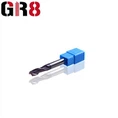
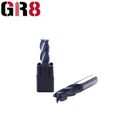
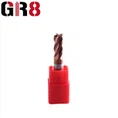
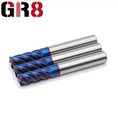
Milling cutters made of carbide are primarily utilized in CNC machining centers and CNC engraving machines. They're also suitable for mounting onto a conventional milling machine to work on moderately hard heat-treated materials that are not overly complex.
Milling cutters come in different types, and each type serves a specific purpose. Therefore, it is vital to have basic knowledge about milling cutters and their intended use when selecting a milling cutter. It is essential to understand that all milling cutters are not created equal. The selection of a milling cutter primarily depends on its type and purpose. Hence, it is imperative to have a good understanding of different milling cutter types and their intended functions.

1. Carbide cylindrical milling cutter:
When it comes to machining planes on horizontal milling machines, there are several types of milling cutters to choose from. These cutters have teeth that are arranged around their circumference, with some featuring straight teeth while others have helical teeth. In terms of tooth shape, you'll find coarse teeth and fine teeth.
If you're looking for a rough machining option, you may want to consider a helical-tooth coarse-tooth milling cutter. This type of cutter has fewer teeth than its fine-toothed counterparts, but that doesn't mean it's any less effective. In fact, its high tooth strength and large chip space make it perfect for roughing out material.
On the other hand, if you need to finish off a piece, you'll likely want to choose a fine-toothed milling cutter. This type of cutter has more teeth, which allows it to make smoother cuts. Plus, its tooth arrangement means that it can produce smaller chips, ideal for getting a polished finish on your workpiece.
2. Carbide face milling cutter:
The end mill is a versatile tool used for milling planes on vertical milling machines, gantry milling machines, and face milling machines. It has cutter teeth on both the end face and circumference, with coarse and fine teeth for precision cutting. The end mill is available in three structures: integral, insert, and indexable types. Each type comes with its own unique advantages and is chosen based on the machining needs of the job at hand. No matter what type of structure is used, the end mill is an essential tool for any machinist looking to achieve precise and accurate cuts.
3. Carbide End Mills:
This tool is specifically designed for machining grooves and stepped surfaces. Its cutter teeth are positioned on both the circumference and end face, allowing for efficient operation. However, it should be noted that axial feeding is not possible during normal operation. Only when the end mill is equipped with end teeth that extend through the center, can axial feeding be achieved.
4. Carbide three-sided milling cutter:
The tool is designed for machining different types of grooves and stepped surfaces. It features cutting edges on both sides and around the tool's circumference.
5. Carbide angle milling cutter:
There are two types of milling cutters, single-angle and double-angle, which are used for grooving at an angle.
6. Carbide saw blade milling cutter:
To efficiently machine deep grooves and cut workpieces, it is beneficial to have a greater number of teeth distributed along the circumference of the cutting tool. This arrangement helps to minimize friction during milling operations. Additionally, to further enhance the milling process, the cutter teeth are designed with 15′~1° secondary declination angles on both sides. This incline promotes smoother material removal and improves the overall machining performance. Moreover, in order to cater to diverse milling needs, there are specialized cutters available, such as keyway milling cutters, dovetail milling cutters, T-slot milling cutters, and various forming milling cutters. These cutting tools are designed to meet specific requirements and facilitate precision machining tasks.